


How Often Should You Retwist Locs Signs It Is Time for Maintenance
- Jae Rashawn
- Aug 7
- 8 min read
A fresh retwist feels good. The parts are clean, the roots are laid, and the style looks polished. But locs are not meant to stay freshly retwisted every day. New growth is normal, frizz is normal, and a little fullness at the roots is part of healthy loc maintenance.
The real question is not just how often to retwist locs. The better question is, “Are my roots ready, or am I retwisting because I want them to look fresh all the time?”
At Jae Stylez in Stafford TX, a lot of loc clients come in from around Greater Houston with this exact question. Some are worried they waited too long. Others are trying to keep their locs neat but do not want to cause thinning. The goal is balance.

Most locs need a retwist every 4 to 8 weeks
For many people, a loc retwist every 4 to 8 weeks is a good starting point. That range gives the hair time to grow, rest, and settle without letting the roots become too tangled.
Some clients do best closer to 4 weeks. Others can comfortably go 6 to 8 weeks. A few may go longer, especially with mature locs or interlocking.
Your timing can change based on:
How fast your hair grows
How much you sweat
Your hair texture and density
The age of your locs
Your scalp health
Your styling habits
Whether you wash often between appointments
If your roots are palm rolled or maintained with interlocking
Starter locs usually need more consistent maintenance in the beginning. The parts are still forming, the locs are still learning their shape, and the hair can unravel more easily. If your locs are still in the starter stage, it helps to follow a regular plan. You can read more about that on the Starter Locs page.
Mature locs often have more flexibility. Once the loc itself is solid, the main focus becomes root care, parting, scalp health, and avoiding unnecessary tension.
Signs it is actually time for a retwist
New growth alone does not always mean your locs need maintenance today. Most people will see new growth within a couple of weeks after a retwist. That does not mean anything is wrong.
It may be time for loc maintenance when you notice several of these signs at the same time.
Your parts are hard to see
A little softness around the parts is normal. But if the parts are disappearing and the roots are growing into each other, maintenance may be needed.
This matters because locs can start marrying at the roots. That means nearby locs begin joining together. If you wait too long, separating them can take more time and may feel uncomfortable.
Your roots are tangling together
If you run your fingers gently near the scalp and feel several locs connected at the base, that is a sign to schedule maintenance. Do not yank them apart at home. Pulling can break hair or weaken the root.
Your style no longer holds
If ponytails, barrels, two-strand twists, or simple down styles are not sitting right because the roots are too loose, your locs may be ready.
Style should not be the only reason to retwist, but it can show that the roots need attention.
You have buildup at the roots
Product buildup, sweat, oil, lint, or flakes can collect near the scalp. A good wash and proper retwist can help reset the hair. If buildup is heavy, the focus should be cleansing first, not forcing the roots to look neat.
Your starter locs are unraveling too much
Some unraveling is expected with starter locs, especially with softer textures or frequent washing. But if several locs keep coming loose, book maintenance before too much of the starter pattern is lost.
What new growth should look and feel like
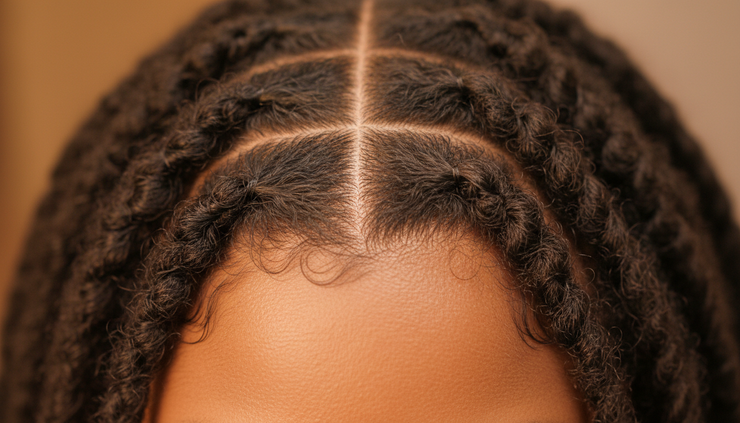
Healthy new growth is soft, full, and a little fluffy. It may not match the neat look of the retwisted hair below it, and that is okay.
Normal new growth can look like:
Puffy roots after a couple of weeks
Frizz around the base of each loc
Looser curls close to the scalp
Parts that are still visible but not sharp
A fuller look at the crown or sides
New growth is not a problem by itself. In fact, it is a sign your hair is growing. The concern starts when the roots become tangled together, stressed, thinning, or hard to separate.
What happens if you retwist too often
Retwisting too often can cause more problems than people realize. A fresh look is nice, but the roots need time to rest.
If locs are retwisted too often, especially tightly, it can lead to:
Tender scalp
Thinning around the hairline
Weak spots near the root
Breakage from repeated tension
Locs that feel smaller at the base
Less fullness over time
The roots should not feel sore after maintenance. A clean retwist can feel snug, but it should not hurt. Pain is not proof that the style will last longer. It is usually a sign the hair is under too much stress.
Be careful with frequent tight styles right after a retwist too. Pulling fresh roots into high ponytails, tight buns, or heavy updos can add extra tension. If the scalp feels tight when you blink, raise your eyebrows, or turn your head, that style is too tight.
What happens if you wait too long
Waiting longer is not always bad. Some clients like a fuller look and can go several weeks without any issue. The problem is going too long without checking the roots.
If you wait too long, you may notice:
Locs joining together at the roots
Parts becoming uneven
More shedding trapped near the scalp
More time needed during maintenance
Breakage from trying to separate tangled roots
Starter locs losing their shape
The longer the roots stay tangled, the more careful the maintenance needs to be. A stylist may need to separate slowly, cleanse well, and rebuild the parting pattern. That can take more time than a regular appointment.
If you are not sure if your roots are past due, look through the hair gallery to compare neat maintenance with healthy, lived-in roots. Photos can help you see the difference between normal fullness and roots that need attention.
Palm rolling and interlocking are not the same
Most people talk about retwisting as if every method is the same. It is not. Palm rolling and interlocking both maintain loc roots, but they behave differently.
Palm rolling gives a softer retwist
Palm roll maintenance uses the hands to roll the new growth in the same direction as the loc. It is common for traditional loc retwist appointments and gives a clean, smooth look.
Palm rolling is a good fit for many clients who like a softer finish and regular styling. It usually needs to be refreshed more often than interlocking because the roots can loosen faster with washing, sweating, and daily care.
Interlocking can last longer for some locs
Interlocking uses a tool or fingers to guide the new growth through the base of the loc. It can hold longer than palm rolling and may work well for clients who sweat often, work out, wash frequently, or have a looser curl pattern.
Interlocking still needs to be done carefully. If the pattern is too tight or done incorrectly, it can create weak spots. If you are curious about this method, visit the Interlocking service page before deciding which maintenance style fits your locs.
Maintenance method | Typical timing | Best suited for |
Palm rolling | About 4 to 6 weeks for many clients | A softer retwist, traditional loc styling, regular upkeep |
Interlocking | About 6 to 8 weeks or longer for some clients | Active lifestyles, frequent washing, roots that loosen quickly |
How to care for roots between appointments
Good root care between appointments keeps your locs healthy and makes maintenance easier.
Start with the basics.
Keep your scalp clean
Avoid heavy products at the roots
Separate locs gently after washing
Sleep with a satin or silk scarf, bonnet, or pillowcase
Avoid tight ponytails and heavy styles
Do not twist your roots every day
Keep hands out of your hair when possible
The habit that causes trouble for many clients is “mini retwisting” at home. Twirling the same locs over and over can thin the root. It may feel harmless, but repeated twisting in one spot can weaken the hair.
If a loc is bothering you, smooth it lightly and leave it alone. Save the real maintenance for the appointment.

Yes, you can wash locs between retwists
Some clients avoid washing because they want the retwist to last. Clean hair matters more than keeping every root perfectly laid.
You can wash locs between appointments. The key is being gentle and drying the hair well.
A few tips:
Focus shampoo on the scalp
Let the lather run through the locs
Rinse longer than you think you need to
Use light products that do not leave heavy coating
Dry the roots fully
Gently separate locs after washing
If your retwist loosens after washing, that does not mean the appointment was done wrong. Water softens the hold, especially with palm rolling. The loc itself is still intact.
If you work out, sweat often, or deal with Houston humidity most days, washing may need to happen before your next appointment. Clean roots support healthy loc maintenance better than product covering up sweat or flakes.
Talk to a stylist if you see thinning or weak roots
Thinning should not be ignored. A little shedding is normal, but visible weak spots need attention early.
Talk to a stylist if you notice:
Locs hanging by a few strands
Roots that look much thinner than the loc
Bald-looking areas between parts
Tenderness that keeps coming back
Breakage around the hairline
A loc that feels like it may detach
A Houston loc stylist can look at the root, the part size, the loc weight, and your maintenance pattern. Sometimes the answer is spacing out retwists. Sometimes the loc needs repair, a lighter style, or a different maintenance method. In some cases, the scalp may need care beyond styling.
Do not keep tightening weak roots to make them look neat. That can make the problem worse.
A simple timing guide for your next appointment
Use this as a general guide, not a strict rule.
Loc stage or lifestyle | Maintenance timing to discuss |
Starter locs | About every 4 weeks |
Traditional mature locs | About every 4 to 6 weeks |
Mature locs with slower growth | About every 6 to 8 weeks |
Frequent workouts or heavy sweating | A shorter schedule may help |
Interlocked roots | Often 6 to 8 weeks or longer |
Thinning or weak roots | Ask a stylist before retwisting |
The best schedule is the one that keeps your roots clean, separated, and strong without overworking them.

Frequently asked questions
How often should locs be retwisted?
Most locs do well with a retwist every 4 to 8 weeks. Starter locs often need more consistent care, while mature locs may be able to go longer. The right timing depends on growth, scalp needs, lifestyle, and the condition of the roots.
Can retwisting too often damage locs?
Yes. Retwisting too often can stress the roots, especially if the retwist is tight or followed by tight styling. Over time, that tension may lead to thinning, soreness, or breakage.
What happens if I wait too long for a retwist?
Waiting too long can cause locs to marry at the roots, parts to become harder to find, and maintenance to take longer. Some fullness is fine, but roots that are tangled together need attention.
Is a retwist better than interlocking?
Neither one is better for everyone. A loc retwist with palm rolling gives a softer finish and is common for traditional maintenance. Interlocking can last longer and may work well for active clients or hair that loosens quickly. A stylist can help choose the best method for your roots.
Can I wash my locs between retwist appointments?
Yes. Clean locs are important. Wash gently, rinse well, dry the roots fully, and separate the locs carefully afterward. Your retwist may soften after washing, but clean hair is better than buildup.
Ready roots do not need to be rushed
Loc maintenance should support the health of the hair, not fight it. New growth is normal. Frizz is normal. A fresh retwist is not meant to last forever, and roots do not need to be tightened every time they look soft.
If your parts are disappearing, your roots are tangling, your starter locs are unraveling, or your scalp is ready for a clean reset, it may be time to schedule maintenance.
For clients in Stafford TX and Greater Houston, review the Jae Stylez Loc Retwist service to see what the appointment includes. If your roots are ready, you can also check available appointments and choose a time that fits your maintenance schedule.


Comments